
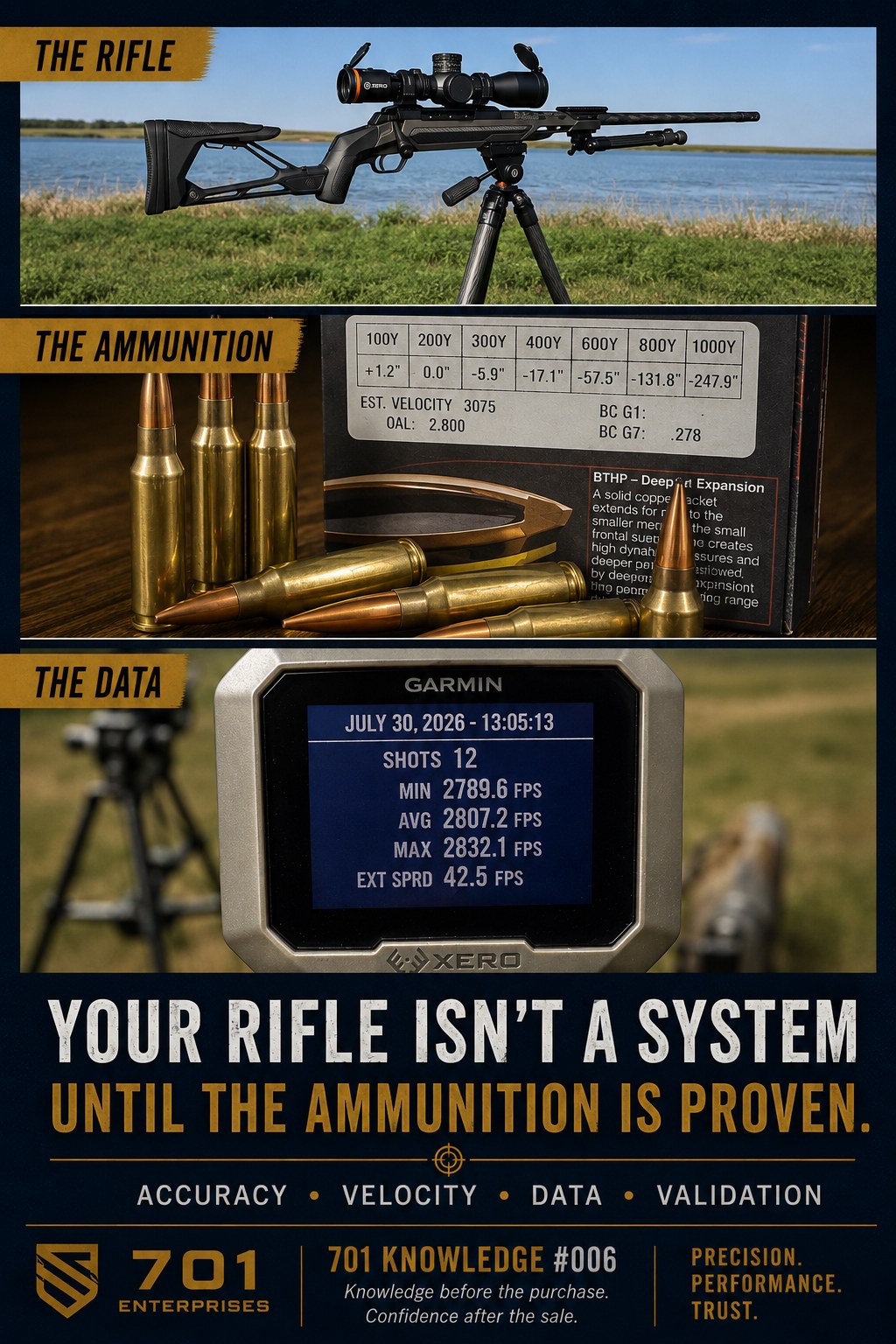
Accuracy. Velocity. Consistency. Validation.
A premium rifle, premium optic, and premium ammunition do not automatically create a proven hunting system. Confidence comes from testing how the complete setup performs together.
The Box Is a Starting Point
Factory ammunition gives us valuable information. Bullet weight. Advertised velocity. Ballistic coefficient. Cartridge specifications.
But the number printed on the box isn't necessarily the number your rifle is producing. Barrel length, chamber, environmental conditions, ammunition lot and the individual rifle can all influence actual performance.
If the box says 3,000 fps and your rifle is actually producing 2,900 fps, that difference may not seem particularly important at 100 yards. Start stretching the distance, though, and incorrect inputs begin producing incorrect predictions.
Step 1: Prove the Accuracy
This is where most shooters start — and understandably so. Put the rifle on paper and see what it does.
But there's an important distinction between “This ammunition shot a good group” and “This rifle consistently shoots this ammunition well.”
One impressive three-shot group doesn't necessarily prove much. Shoot enough to understand whether the performance is repeatable. Does the rifle consistently group? Does the point of impact remain predictable? Does the ammunition continue performing as the barrel goes through multiple shooting sessions?
We're looking for a pattern, not a photograph of the best group we've ever fired.
Step 2: Know Your Actual Velocity
If you're going to rely on ballistic calculations, velocity matters.
A chronograph allows you to replace advertised velocity with something much more useful: actual velocity from your rifle.
And don't become obsessed with only the highest number. We're more interested in understanding what the ammunition normally does. If you're seeing large variations from shot to shot, that's information worth paying attention to.
The objective isn't simply “How fast is it?” It's “How consistently does it perform?”
Step 3: Build the Data
Once you have confidence in accuracy and a realistic velocity, you can begin building useful ballistic data. This is where your rifle, ammunition and optic start becoming a connected system.
Your ballistic solver needs accurate inputs. That includes actual muzzle velocity, bullet information, sight height, zero distance, atmospheric conditions, and other relevant rifle and ammunition information.
Better inputs generally give you a better starting prediction. But there's an important word there: prediction.
A ballistic calculator doesn't fire the rifle. You do. Which brings us to the part that matters most.
Step 4: Verify It With Actual Impacts
This is where confidence gets built.
Take the rifle beyond your zero distance and compare what the ballistic solution says should happen with what actually happens on target.
If your solver calls for an adjustment, dial it. Build a stable position. Make a good shot. Then observe the impact.
As distance increases, small errors in your inputs become easier to identify. Maybe your velocity needs refinement. Maybe another input needs to be checked. Maybe everything lines up exactly as expected.
Either way, you're learning something about your actual rifle system rather than simply trusting numbers on a screen.
Don't “True” Bad Shooting
Not every miss means your ballistic data is wrong.
Poor position, inconsistent recoil management, bad wind calls and shooter error can all move an impact. If you immediately start changing ballistic inputs every time a shot doesn't land exactly where expected, you can end up adjusting good data to compensate for bad shooting.
That's why validation requires judgment. Look for repeatable trends, not individual shots.
One unexplained impact is information. Several quality shots showing the same trend are evidence. There's a big difference.
What About Wind?
Wind deserves its own category because it's one of the easiest variables to blame on equipment.
Your rifle can be shooting exceptionally well. Your velocity can be correct. Your elevation solution can be nearly perfect. And a poor wind call can still move the bullet considerably.
That's another reason we like separating equipment validation from shooter validation. When proving ammunition and ballistic data, start by removing as many variables as reasonably possible. Then, as confidence grows, practice under increasingly realistic conditions.
The Hunting Connection
This is ultimately why we're doing all of this.
We're not trying to turn every hunter into a ballistician. We're trying to eliminate uncertainty.
When an animal is standing in front of you, that's a terrible time to wonder: Is this actually my velocity? Is my ballistic solution correct? Does this ammunition really shoot well from this rifle?
Those questions should have been answered before hunting season. At that point, your attention belongs on the things you can't completely control: the animal, the wind, the position, the time available, and whether the shot should be taken at all.
The equipment side should already be known.
Premium Components Don't Replace Proof
You can spend a lot of money assembling an exceptional setup. Premium rifle. Premium optic. Premium ammunition. Rangefinder. Ballistic solver. Suppressor. Bipod.
None of those components eliminates the need to test the complete system.
In fact, the more capability your equipment gives you, the more important validation becomes. Because increased capability can create increased confidence.
We want that confidence to be earned.
The 701 Take
We don't think a rifle becomes a complete hunting system when the last accessory gets installed. It becomes a system when the pieces have been tested together.
Find ammunition the rifle consistently shoots well. Measure what it's actually doing. Build your ballistic solution around real information. Then take it to the range and verify that information with actual impacts.
If something doesn't match, figure out why. Keep validating until the rifle stops giving you surprises.
Because when the hunting opportunity you've been waiting for finally appears, you shouldn't be wondering whether your equipment will perform. You should already know.
Don't assume your ammunition is proven because it shot one good group at 100 yards. Confirm the accuracy. Confirm the velocity. Confirm the consistency. Confirm the data at distance. Then trust the system.
Knowledge before the purchase. Confidence after the sale.
Precision. Performance. Trust.